


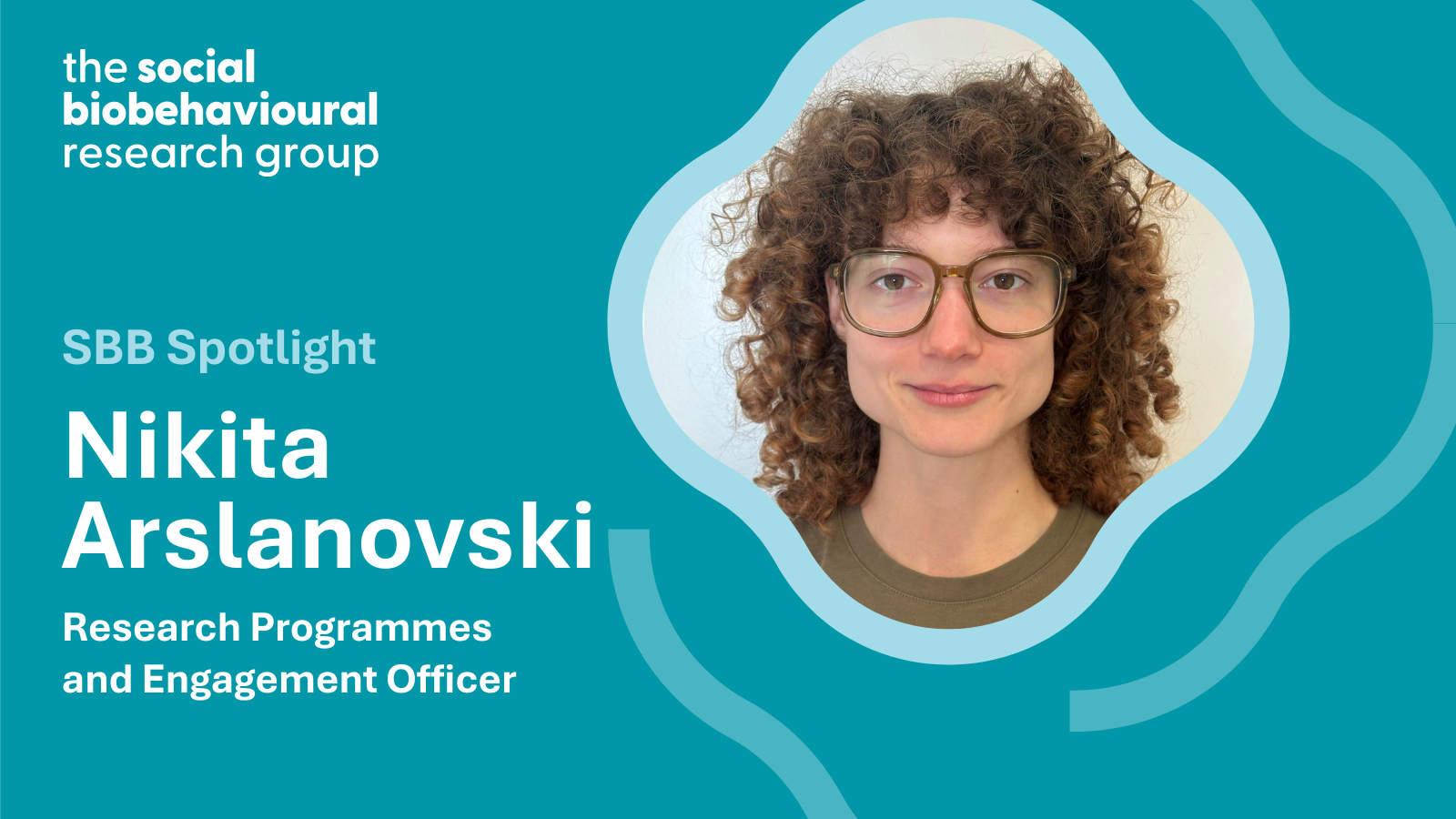
Meet Nikita Arslanovski, Research Programmes and Engagement Officer at the Social Biobehavioural Research Group. Nikita works across finance, events and communications, ensuring that research can happen and that its findings reach and engage the target audiences.
Read on to learn about her role managing the team’s funding portfolio, coordinating our flagship training programme and the Social Prescribing Youth Network – she also shares the key learnings that emerged from SPYN since our team took over facilitating the network.
Q: Could you tell us a bit about your role as Research Programmes and Engagement Officer? What does a typical week look like for you?
No two weeks are the same! My role spans managing our grant portfolio, developing the group’s communications together with my colleagues Rachel and Nancy, coordinating the Social Prescribing Youth Network as well as organising events and capacity building activities.
We recently held our flagship course, the Arts Health Research Intensive, which I lead on coordinating. I spend most weeks in the leadup to it answering queries about the course and liaising with the venue. We just wrapped up our reflections and reviewed the feedback of our 2026 edition. In the next few weeks, I’ll start working on a communications campaign to recruit the next cohort. If you’re curious about the course, you can read our latest recap blog and register your interest in the 2027 edition.
I also manage the group’s research funding. This means that in an ordinary week, I’m likely to be doing one or more of the following: tracking, forecasting or reviewing our expenditure (think: Excel spreadsheets), helping set up a new grant or close one that recently ended, or drafting reporting documents.
Bi-monthly you’ll also find me reviewing new research papers, collating news from the team and tracking media mentions to share the exciting updates in our newsletters, blogs, and on social media.
Q: How did you find your way into research engagement and to the Social Biobehavioural Research Group?
Before joining UCL, I worked at a medical communications agency, producing educational websites, animations, and e-learning resources across disease areas, ranging from rare metabolic disorders to travel health. I also had experience working in higher education media and communications, so I knew I enjoyed working with academics and being close to the cutting-edge research they conduct.
When I came across the role in the research group, I was in the middle of an art residency at Camden Art Centre, which was an exciting opportunity following on from my involvement in their Transformative Futures art collective – a nurturing experience that showed me the wellbeing benefits of the arts first-hand. I was thrilled to learn that my lived experience was backed by evidence and enthused by the prospect of working with the research group that pioneered some of it.
The job matched my skillset and combined my interests in mental health (I studied Neuroscience) and addressing the social determinants of health, so I had to take it when it was offered! Nearly 3 years on, it continues to be an exciting and evolving role, full of opportunities to grow and develop alongside passionate colleagues.
Q: Are there any recent projects, events, or initiatives you’ve particularly enjoyed working on?
Coordinating the Social Prescribing Youth Network (SPYN) has to be one of my favourite projects I’ve worked on so far. I was proud to have secured Higher Education Innovation Funding (HEIF) as Co-Investigator to help reinvigorate the Network. Over the past year, with colleagues Rachel and Dan, and our partners, the National Academy for Social Prescribing and the Southbank Centre, we’ve managed to achieve more than that!
We convened roundtables with stakeholders, published our findings on the state of the sector and ways forward in best practice guidelines, developed new training, and organised a national Youth Social Prescribing Symposium, all while hosting several Member Meetups and producing numerous newsletters to share the latest updates on youth social prescribing throughout the year.
The project was a real team effort that greatly helped me hone my skills and form new connections. I’m excited to keep developing the Network!
Q: That sounds impactful! Do you have any learnings to share from working with so many different stakeholders – researchers, practitioners, community organisations?
Yes, absolutely! Coordinating SPYN has been a huge learning experience. Thankfully my colleagues already knew the importance of good governance, so that was one of the first things we focused on. Having an engaged Advisory Board and Youth Advisory Group (the latter we created from scratch), was instrumental to the success of the Network.
Getting young people involved in shaping SPYN’s work was a welcome task – their fresh ideas and enthusiasm were incredibly energising. Facilitating group discussions reminded me of the importance of listening actively and being adaptive. It also encouraged me to engage with the literature and best practices for patient and public engagement, a key component of the research we do.
Through my involvement in SPYN, I also learned a lot about how to form and maintain partnerships between academic and third sector organisations. This experience highlighted the importance of interpersonal relationships, clear communication, and flexibility for partnership success.
But the learning doesn’t stop there! Alongside my work for the research group, I’m also studying part-time for an MSc in Health Policy, Planning and Financing. I recently completed my first year with new knowledge on the role of evidence in the policymaking process, and a greater understanding of the principles and applications of health economics and economic evaluation, as well as with a few new Excel tricks – I look forward to continuing to implement these in my day-to-day.
Q: Seems like you have your hands in a little bit of everything… What can we expect to see from the Social Biobehavioural Research Group in the next few months?
Indeed! I’m often liaising with team members, working out how I can best help them move projects forward, be it through assisting with contracts, reviewing budgets, or funder’s documentation. There’s a lot going on behind the scenes and it’s satisfying to see the administrative bits I do enable the research.
In terms of the next few months, many of our team members are taking a well-deserved break over the summer, before the new academic year begins. In August, we’ll be planning SPYN activities for the year ahead, hosting international partners working on the GRACE-Epi project (stay tuned for more details!), continuing our Monthly Methods webinar series, then starting recruitment for the next edition of the Arts Health Research Intensive in September, and continuing to post about new research papers as they are published.
The best way to stay up to date with the research group is to subscribe to our newsletter (and I don’t say this just because I want you to read more of my writing).
Q: Thank you for this conversation. We like to end this series on a more personal note. What hobbies, creative pursuits or interests do you enjoy outside of work?
Yoga has been a constant for me for the past couple of years – the focus required reminds me of the years I spent in a karate dojo when I was younger. In terms of creative hobbies, I like to dabble, but always return to collaging and zine-making, ideally with a group of friends and music playing in the background. Oh, and I’ve been trying to get into racket sports, although I’m sadly still much better at ping pong than tennis.