


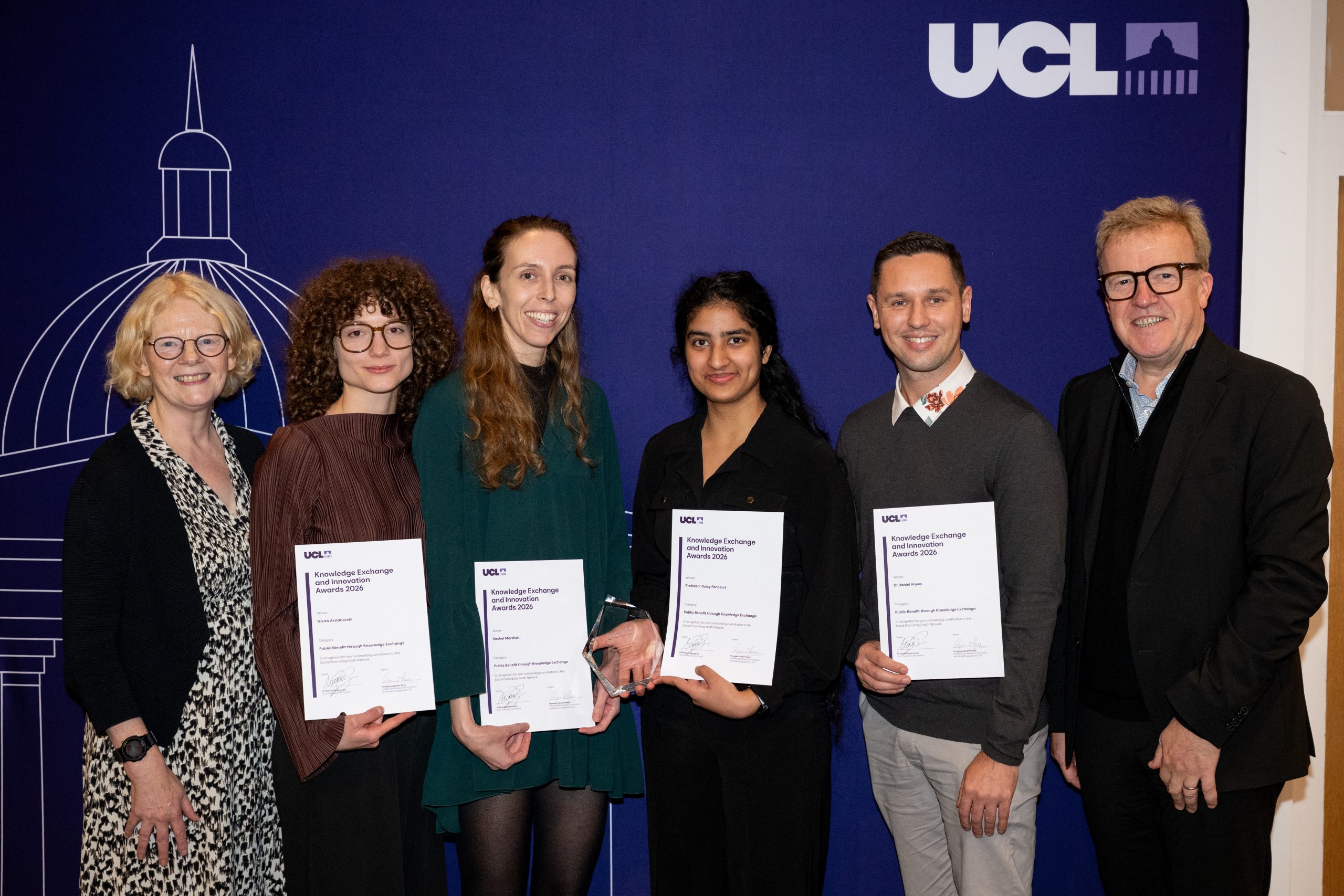
Pictured: Kathryn Walsh, Nikita Arslanovski, Rachel Marshall, XazQ Sandhu, Dr Daniel Hayes, Professor Geraint Rees.
The UCL Knowledge Exchange and Innovation Awards, run by UCL Innovation and Enterprise, recognise and celebrate students, alumni and staff across nine categories, showcasing how the UCL community is creating positive change.
The Social Prescribing Youth Network (SPYN) team, led by Dr Daniel Hayes, Professor Daisy Fancourt, Rachel Marshall, and Nikita Arslanovski, were awarded the Public Benefit through Knowledge Exchange award, celebrating effective collaboration with communities, policy makers or civic organisations to create positive change. To celebrate and accept the award, they were joined by XazQ Sandhu, a representative from the SPYN Youth Advisory Group.
A huge thank you to the SPYN members, Advisory Board, Youth Advisory Group and partners the National Academy for Social Prescribing and the Southbank Centre for making this work possible.
About the Social Prescribing Youth Network
SPYN is a free network, with over 1,300 members, dedicated to bringing social prescribing and its benefits to the younger generations. The Network is open to everyone from practitioners and researchers to policymakers and people working in healthcare.
The SYPN team has significant expertise in youth social prescribing research, implementation science, health inequalities and community-based mental health support.
Over the last two years they have undertaken a suite of activities to identify and share best practice with those interested or working in the field. This includes hosting five national roundtable events, bringing together nearly 70 young people, link workers, community organisations, researchers, commissioners and policy makers.
Off the back of these events, the team has co-created guidelines and online training, as well as hosting a national symposium at London’s Southbank Centre. Insights generated through the SPYN are now leading to the co-development of a school-based youth social prescribing pathway, which is being tested across 30 secondary schools to support 400 pupils experiencing high levels of loneliness.