


Introduction
Social prescribing has been successfully rolled out across England since 2019, with millions of people referred to Link Workers and a growing evidence base to show its positive impact. As the NHS enters a new phase, it will be crucial to use data and evidence to develop and target social prescribing services further, evaluate the benefits and inform investment.
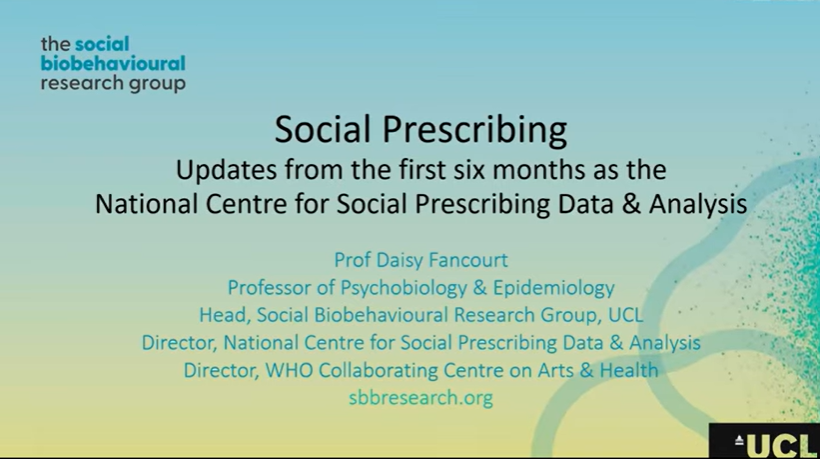
To that end, the National Academy for Social Prescribing (NASP) and the Social Biobehavioural Research Group at UCL have formed a new partnership to develop a National Centre for Social Prescribing Data and Analysis. This fulfils one of the key recommendations from NASP’s 2023 report, The Future of Social Prescribing in England. The partnership combines NASP’s reach into communities and expertise in policy development and advocacy with UCL’s world leading research and analysis capability.
Aims
The aims of the Centre are to:
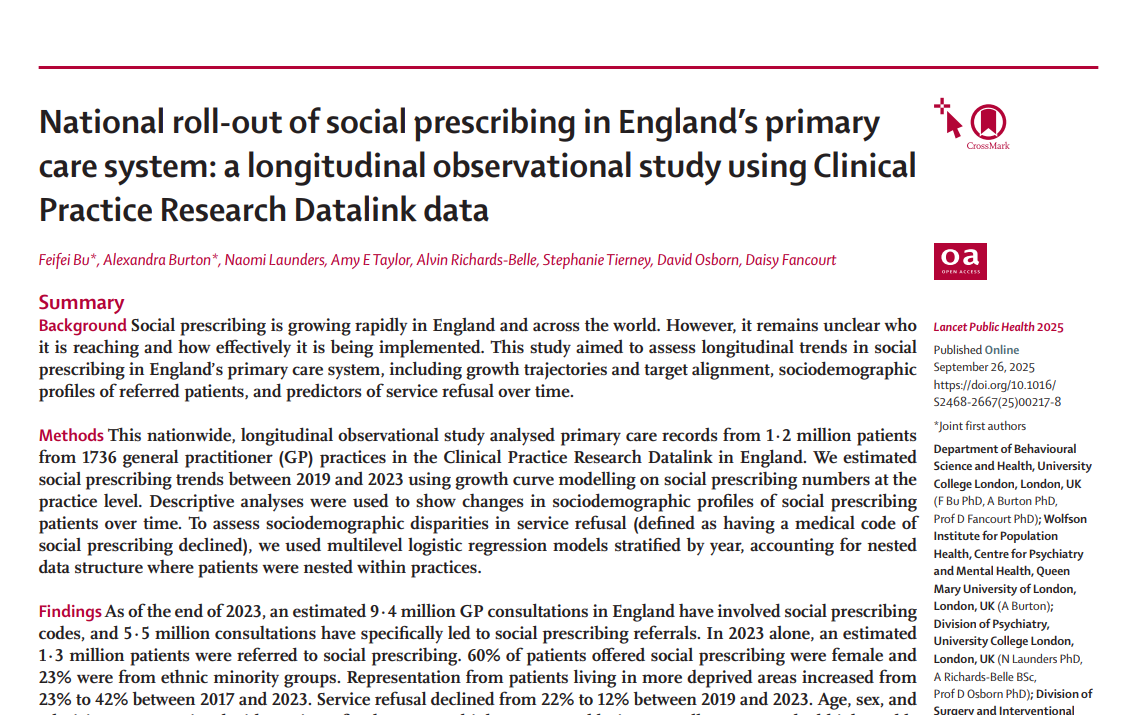
- Produce and promote a series of seminal reports on the impact of social prescribing across the English population, using large datasets from multiple sources including Access Elemental and the Clinical Practice Research Datalink (CPRD), to demonstrate impacts through innovative methods of data analysis and utilise these for the national strategic development of social prescribing.
- To co-design with key stakeholders a long-term national data and analysis strategy for social prescribing, to create a step change in the quality, depth and breadth of analysis required to inform future policy, investment and practice.
Outcomes
This National Centre is key to transforming timely access to high quality, robust data required to inform many of the changes underpinning the Government’s shift to a more pro-active, sustainable health service focused on health prevention delivered with and through the community. The Centre’s work will build on the growing body of evidence around social prescribing, and NASP’s ambition for a high quality data-driven system, ensuring timely and coordinated analysis of social prescribing data within a long term strategic plan.
Work in 2025/26 will commence with the design and development of a long-term data and analysis strategy for social prescribing, alongside the sharing of new evidence on the scale of social prescribing across England.
Our social prescribing research
Social prescribing is a major focus of our research at the Social Biobehavioural Research Group. You can find an overview of relevant current and past projects below.
- Wellbeing while waiting (‘INSPYRE’) – Exploring how social prescribing can help young people waiting for NHS mental health support
- INcreasing AdolesCent social and community supporT (INACT) – Understanding how schools and local community resources can work together to improve outcomes for pupils
- SP:ACE (Social Prescribing: Advancing Child and youth Evidence, policy and practice) – Catalysing international policy, practice and research for social prescribing and youth mental health
- YES: Youth sector Enabling Social prescribing – Investigating the impact of youth sector provision on young people’s mental health
- EpiArts Lab – Working with the University of Florida to explore how the arts are linked to health outcomes in the USA
- One Nation One Project – A major national evaluation of social prescribing across 18 sites in the USA
- Social Prescribing and electronic patient records – Using data from the Whole Systems Integrated Care (WSIC) dataset to evaluate the impact and outcomes of personalised care across North West London
- The psychological, social and economic impact of musculoskeletal conditions – Using cohort study and social prescribing data to explore peoples’ experiences of musculoskeletal conditions
- Social Prescribing for Severe Mental Illnesses (SuPreME) – Improving access to social prescribing for people with severe mental illnesses
Additionally, as part of our work to advance this field we also host the Social Prescribing Youth Network (SPYN), a free network open to anyone interested in social prescribing for children and young people.
To learn more about our social prescribing research, watch Prof Daisy Fancourt’s recent Lunch Hour Lecture answering the question: “Social Prescribing: ground-breaking or gimmicky?“.